What a good site meeting looks like
A site meeting is not a tour. It is the hour when RFIs, variations and hold points are made to stand still long enough to be decided. Here is who must be there, what the minutes must bind, and when the superintendent speaks.
By Tom Rafter, Construction editor · 7 min read
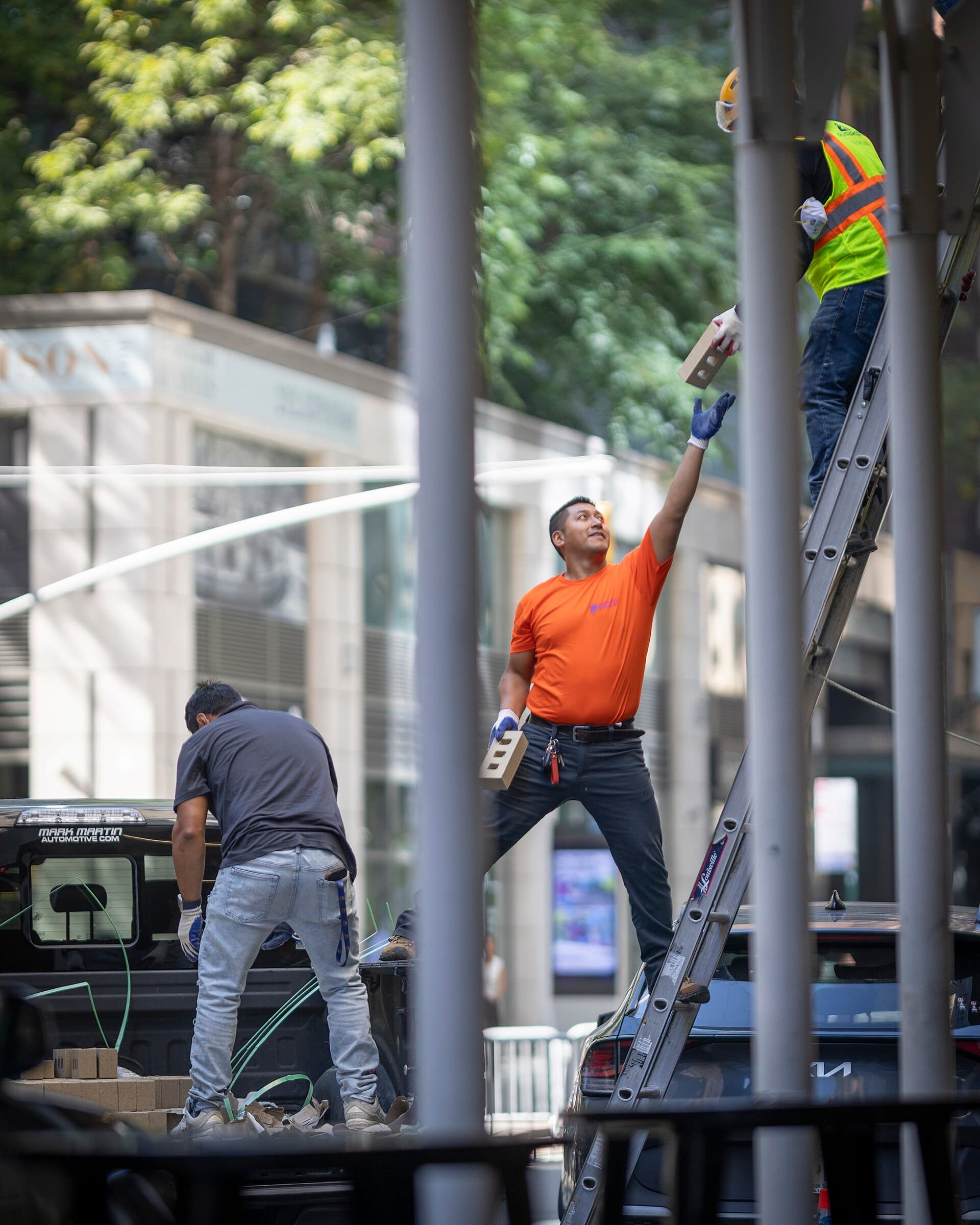
Image: Tessa Bury. CC BY 4.0. See the image credits.

A site meeting that works is a short, slightly uncomfortable hour. It is held on the job, standing near the thing that is late, with drawings marked since last week. It is not a walk-through for relatives. It is the weekly moment when the job is forced to tell the truth about money, time and the questions sitting in inboxes.
Australian contracts are full of people who may instruct and people who may only observe. The meeting is where those roles hold or collapse into a chat. If you want the building you drew, you need an hour that practice would recognise: an agenda, the right people, a record that binds, and a superintendent who knows when to speak and when to write.
Why the meeting exists
The job generates more information than anyone can hold. A window that will not fit. A beam forty millimetres short. A client who has decided the ensuite should swap with the robe. None of that is a crisis if it has a home. Without a meeting, the same facts travel as texts and "I thought you knew". The meeting also protects people who are not in the room. If the decision is not written, they will live with three versions of it. Keep it formal enough that a new supervisor could pick up last month's minutes and know what was instructed, deferred and refused.
Minutes are the contract's weekly memory. If they are vague, the job will remember whatever is cheapest.
The agenda that earns the hour
Send the agenda the afternoon before, with attachments, or do not bother calling it a meeting. An agenda that is invented on the bonnet of a ute is a conversation. Conversations do not bind.
Keep it short and in the same order every week so people know when to speak:
- Safety and access: what changed, who is on site, any incident
- Programme: last week's dates against this week's facts
- Inspections and hold points: booked, passed, failed, outstanding
- RFIs: open, answered, overdue
- Variations: proposed, priced, approved, rejected
- Information required: drawings, schedules, client selections
- Next week: the three things that will stop the job if they slip
If an item is not on that list, it waits or it is a separate meeting. Design reviews do not belong in a site meeting unless the design is stopping the next pour. Procurement lectures do not belong there at all.
Time-box the hour. Forty-five minutes is civil. Ninety minutes means the agenda was a novel. Walk the site after the table work, not instead of it, and walk only the two or three locations that are in dispute. A full tour is how you lose the plumber who came for one answer.
Who must attend
The people who may instruct
Presence is a cost. Treat it that way.
The builder's site supervisor must be there. Not a labourer who "knows the job", and not an estimator who last saw the site at tender. The person who will instruct the trades tomorrow is the person who must hear the instruction today.
The contract administrator must be there: architect, superintendent, or a project manager with authority written down. If that person sends a junior "to take notes", you have already decided that nothing important will be decided.
The client attends when the decision spends money or changes the brief. A client who comes every week and redesigns the skirting is not engaged. They are unsequenced. Give them a selections schedule with dates.
Consultants come for their item. Book them at a time, take that item first, and let them leave. Trades come when the question is theirs. A leading hand standing through an hour of preliminaries is a person you are paying to resent you.
If the superintendent's role is split — architect for design, a separate superintendent for time and money — say so on the attendance list. Ambiguity about who may instruct is how two emails contradict each other on a Friday afternoon.
RFIs: questions that have a home
A request for information is not a complaint. It is a builder saying: the documents do not let me build this junction without guessing. Treat guessing as a defect in the administration, not as initiative.
A good RFI is specific. It names the drawing, the grid, the conflict, and the date by which an answer is needed if the programme is to hold. A bad RFI is "please confirm all window heads". The first can be answered. The second is a request to redesign the job in an email.
The meeting does not exist to write RFIs. It exists to close them. Read the open list out loud. If an item is older than a week, it needs a reason or a decision. If the architect will "look at it", write the date they will look, and the date they will issue. "Ongoing" is not a status. It is an evasion.
When an RFI answer changes the work, it is no longer an RFI. It is a variation or an instruction. Move it. Leaving a design change on the RFI list is how unpaid work accumulates under a polite heading.
Variations: say the cost before the work
Variations are where site meetings either become adult or become folklore. The rule is older than any contract you are using: do not do the work until the variation is described, priced where the contract requires it, and directed by the person who may direct it.
Emergency work is the exception — a burst pipe, an unsafe wall — and even then the direction should be written the same day. Everything else can wait for a sentence and a number.
Clients hate this. They want the window moved while the framer is standing there, and they want to talk about money later, when it is abstract. Later is when the joinery has been remade and the argument is about memory. The meeting is the place to say: we can move it; here is the effect on time and cost; here is when we need a yes.
A variation register that is updated only at the end of the job is a weapon. A register that is read weekly, with running totals, is a courtesy. Put the running total on the agenda. People behave better when they can see the meter.
Minutes that bind
Minutes are not a vibe summary. They are instructions, actions and refusals, written so that a stranger could administer the next fortnight from them.
Write them the day of the meeting, or the next morning. Circulate them to everyone who attended and everyone who is named. Give a short period for correction of fact — two working days is ordinary — and state that silence is acceptance of the record. Then keep that rule.
Each item needs four things:
- A number that does not change from week to week
- A fact or a decision, in a sentence
- A name
- A date
"Builder to liaise with engineer regarding beam" is not a minute. "Item 47: engineer to confirm 190 PFC at grid C/2 by Thursday 14 August; builder not to fabricate until confirmation issued" is a minute. The difference is whether you can hold someone to it.
Photograph the marked-up drawing and attach it. Words about a junction without a picture are how two trades build two versions of the same corner.
Do not minute jokes, atmospheres or who seemed annoyed. Minute the instruction. If the client rejected a variation, write that they rejected it. Future-you, standing in a dispute, will not thank present-you for being delicate.
When the superintendent speaks
The superintendent — and the architect who is wearing that hat — has two voices. One is conversational: clarifying, asking, thinking aloud. The other is the contract. The meeting falls apart when the room cannot tell them apart.
Speak in the conversational voice while you are understanding the problem. Switch, deliberately, when you instruct. A useful phrase is dull and therefore clear: "That is a direction." Another: "That is not a direction; price it." A third: "No. Build it as drawn." The job can survive an unpopular no. It cannot survive a yes that was only a nod.
There are moments when the superintendent must speak even if the room is tired:
- When two people have given the site opposite instructions
- When work is about to hide a hold point
- When a variation is being treated as included because it is small
- When safety is being negotiated as if it were a finish
- When the programme date being discussed is already dead and nobody will say so
There are also moments to stay quiet. If the builder and the leading hand are solving a setting-out problem that does not change the design, let them finish. A superintendent who redesigns the packers is not administering. They are interfering, and they will own the result.
End the meeting on the three dates that matter next week, spoken aloud, written down. Then leave. The site has work to do. The meeting's job was to make that work possible without argument. If you have done that in an hour, you have done enough. The building will not remember how pleasant you were. It will remember whether the beam was confirmed before it was cut.
Questions from the job
- Who has to attend a residential site meeting?
- The builder's site supervisor must be there, and so must whoever holds the contract administration — architect, superintendent or project manager. The client attends when a decision will spend their money. Consultants attend when their work is on the agenda, not as a courtesy audience. If a decision needs the surveyor or a fire engineer, book them for that item, not for the whole hour.
- Are site-meeting minutes a contract document?
- They become one if the contract says so, or if everyone treats them as the record of instructions. Write them as if a stranger will read them in a dispute. Number the items, name the person, date the action, and circulate them within two working days. Silence after circulation is often taken as agreement. Say so in the minutes, then mean it.
Keep reading in Construction

Construction
Sequencing a residential build in Victoria
A residential job in Victoria is a chain of hold points, not a mood board. This essay walks demolition to handover, and says when weather, inspections and trade bookings actually decide the programme.
Tom Rafter · 1 September 2026
Construction
Why preliminaries eat your budget
Scaffold, cranage, sheds, temp power and insurance are not padding. They are the cost of making a site legal and workable. Here is how preliminaries swell, and how clients misread them in a tender.
Tom Rafter · 30 June 2026
Construction
Working with existing structures: the renovation reality
Opening an old wall is a hypothesis about structure, services and what the last renovator hid. This essay covers temporary support, asbestos, voids, matching levels, and the moment you should stop opening.
Tom Rafter · 2 June 2026