Why preliminaries eat your budget
Scaffold, cranage, sheds, temp power and insurance are not padding. They are the cost of making a site legal and workable. Here is how preliminaries swell, and how clients misread them in a tender.
By Tom Rafter, Construction editor · 7 min read
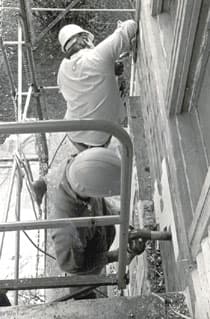
Image: Alan O'Bright / U.S. National Park Service. Public domain. See the image credits.

Preliminaries are the part of a tender that looks like fog. Clients skip to the kitchen. Architects skip to the structure. Builders know the fog is where the job lives or dies. Scaffold does not appear on a mood board. Neither does a twelve-week scissor-lift hire, a builder's pole, or the insurance that lets you open the gate. Those things are how a drawing is allowed to become a site.
When a budget blows out after contract, it is often not the marble. It is the preliminaries that were read as padding and then discovered to be physics. This is about that column: what is in it, why it grows, and how a client reading a builder's tender can stop treating it as optional.
The cost of making the job possible
A construction site is a temporary factory on someone else's land, in weather, next to people who did not ask for it. To exist at all it needs a boundary, a toilet, power, a place to read a drawing, a way to get materials off the truck, and a way to stop a passer-by walking under a beam. None of that is the house. All of that is the job.
Preliminaries are the name we give to that factory. They are time-related as much as they are item-related. A scaffold that stands for eight weeks costs one thing. The same scaffold standing for sixteen weeks, because the windows were late and the plasterer was later, costs another. Clients see a line called "scaffold" and think they are buying a product. They are buying a duration.
That is why preliminaries eat a budget when the programme slips. The brickwork might be finished. The hire clock is not.
Preliminaries are not a tax on the dream. They are the price of being allowed to build it.
Scaffold
Scaffold is safety, access and weather in one ugly rental. On a two-storey Victorian terrace it is also the neighbourly act that keeps bricks off the laneway. Price it as a system: supply, erect, alter, dismantle, and the weeks in between. The alterations are what people forget. Every time a window installer, a renderer or a roofer needs a lift dropped or a bay moved, someone pays. If the tender assumed "one erect, one down", the first alteration is a variation.
Edge protection on a single-storey slab is still scaffold in spirit: a rail, a platform, a way to work without inventing a method on the day. Builders who price this as "use the ladder" are not being frugal. They are transferring risk onto a person and, eventually, onto you.
Ask how long the scaffold is allowed to stand in the tender, and what happens when it stands longer. That question is more useful than asking whether the builder "has scaffold included".
Cranage
Cranage is a day that looks expensive until you try to do the same work with a crew and a prayer. Steel, timber packs, a spa, a long beam over a standing house — these are crane problems. They are also booking problems. A mobile crane in inner Melbourne wants a permit, a traffic plan, sometimes a road closure, and a neighbour who will move the car they swore they would move.
A tender that says "cranage attended" without saying how many visits is a story. Count the visits against the sequence of the build. Frame, steel, joinery, solar, the air-conditioning condenser that will not go up the stair — each can be a separate call-out. A hiab on the delivery truck is not a substitute if the reach is wrong.
Tower cranes belong to a different scale, but the logic is the same: you are buying time in the air. Price the operator, the dogman, the lifts you know, and a contingency for the lift you discover when the joinery truck cannot make the corner.
Temporary power, water and the sheds
Temporary power is not a lead from the neighbour, except on the jobs that later feature in the newspaper. A builder's pole, a temporary board, and enough capacity for welders, a saw and a site shed will cost what they cost. Underspecify it and the job runs on generators, which are a preliminary of their own — fuel, noise, theft, and a conversation with the council.
Water is similar: a metered connection, a hose the excavator will not flatten, enough pressure for a mixer. Dull sentences. They are the difference between a site that works and a site that borrows.
Site sheds are culture as much as amenity. A table for drawings, a place to dry, a lockable box, toilets that meet a labour-hire idea of dignity. Squeeze this line and you pay in lost hours and in who will stay.
On a tight inner block the shed sits on the street or on the slab. Both choices have costs: permits and complaints, or a shed that must move when the frame goes up. Price the move.
Insurances
Insurance is the preliminary that clients most enjoy cutting, because it does not photograph well. Contract works, public liability, and — on a Victorian domestic job — domestic building insurance where the threshold requires it. Plant, tools, and the existing structure on a renovation each have their own questions. If you are opening an old house, the policy must know that.
A cheap tender sometimes assumes the client's house policy will carry the risk during the works. Ask. House policies are often unenthusiastic about missing walls. The gap between "we assumed you had it" and "the fire was in the renovation" is not a place you want to meet a loss adjuster.
Insurances also have a time shape. Extend the programme and you extend the policy. That cost belongs in the same conversation as scaffold hire. It is not a new idea. It is the old idea, still running.
Clean, attendance and the quiet lines
Clean is not a skip at the end. It is the weekly habit that keeps plaster dust out of the tracks and wet trades off last week's floor. A tender that prices one final clean is pricing a myth. Buildings that are cleaned only once are not cleaned. They are disguised.
Attendance is the word that makes clients suspicious. It means the labour that serves other labour: unloading, shifting, protecting, waiting for the inspector, watching the crane. It is real work. If it is not in preliminaries it is hidden in trade rates, or it will not happen.
Supervision sits next to it. Ask how many hours a week the named person will be on site. A preliminary that cannot name that person is not a preliminary. It is a hope.
Waste, traffic management, hoarding graphics, temporary fencing, silt control, and the person who sweeps the footpath before school pickup — all of these are preliminaries with civic consequences. Ignore them and the council will remind you, at a fee.
Programme risk is a preliminary
The most honest preliminary is the one that admits the job might take longer than the brochure. Wet weather, late glass, a surveyor who cannot come Thursday, a protection-works objection, a client who changes the stairs after the set-out — these are not surprises. They are the climate of building.
Some builders price a float and call it contingency. Some price a tight programme and plan to claim extensions. Some price neither and gamble. You can live with the first two if you understand them. The third is how preliminaries "suddenly" double.
Read the programme as a cost document. Every week has a burn rate: sheds, scaffold, crane retainers, insurance, supervision, the temporary crossover you are hiring from the council. If the tender programme is shorter than any comparable job you have watched, the preliminary sum is not competitive. It is incomplete.
How clients misread a tender
Compare the assumptions, not the total
The usual misread is to compare preliminary totals as if they were a single product. The cheaper column must be lean. Then the site opens and that builder has no crane, a scaffold that will not reach the rear gable, and a supervisor who visits fortnightly. You have not saved the difference. You have bought a different job.
The second misread is to treat preliminaries as negotiable fat. "Can we reduce prelims by ten per cent?" means "can we pretend the site will need less time, less safety and less management?" Sometimes there is fat — a double-counted fence, a crane day the steel supplier is already bringing. Find those with a red pen. Do not apply a percentage to the whole column.
The third misread is to move items into "by owner". Temporary power, clean and waste are the favourites. Owners who have done this once do not do it twice. The builder will still need the power. They will invoice the delay when it is late.
Read a tender in this order:
- Duration assumed, and what happens when it blows
- Scaffold and cranage, with visit counts
- Insurances, named
- Supervision hours
- What is excluded, in the same type size as what is included
Then, and only then, look at the kitchen. The kitchen can be specified down. A site that cannot be run cannot. Preliminaries eat a budget when they were never given a plate. Feed them in the tender, or they will feed on the job.
Questions from the job
- What usually sits in a builder's preliminaries?
- Site establishment, fencing, scaffold, cranage or hiab, temporary power and water, sheds and amenities, insurances, clean, attendance, supervision, plant that serves the whole job, and time-related allowances for the programme. Some builders also park protection works, traffic management and waste in the same column. If a line is missing, it is not free. It will return as a variation or a corner cut on site.
- Why do two tenders show such different preliminary sums?
- Because they are pricing different durations, different access, and different appetites for risk. A cheap preliminary often assumes a short programme, a friendly neighbour, and a crane that visits once. Read the assumptions, not the total. The low number is only a bargain if the job will in fact be that simple.
Keep reading in Construction

Construction
Sequencing a residential build in Victoria
A residential job in Victoria is a chain of hold points, not a mood board. This essay walks demolition to handover, and says when weather, inspections and trade bookings actually decide the programme.
Tom Rafter · 1 September 2026
Construction
What a good site meeting looks like
A site meeting is not a tour. It is the hour when RFIs, variations and hold points are made to stand still long enough to be decided. Here is who must be there, what the minutes must bind, and when the superintendent speaks.
Tom Rafter · 3 August 2026
Construction
Working with existing structures: the renovation reality
Opening an old wall is a hypothesis about structure, services and what the last renovator hid. This essay covers temporary support, asbestos, voids, matching levels, and the moment you should stop opening.
Tom Rafter · 2 June 2026